
For the first time since the Great Depression, the United States is experiencing negative net migration, a demographic reversal characterized by a greater number of permanent departures than arrivals.
Recent data indicate that in 2025, the United States experienced a net loss of approximately 150,000 residents, with projections suggesting that this outflow may increase in subsequent years. Although migration is frequently examined through cultural or political lenses, it also produces quantifiable economic effects. Population movements directly affect labor markets, household spending, and demand across industries.
Permanent emigration removes individuals’ income, spending, and economic participation from the domestic economy. An IMPLAN analysis shows that this migration deficit could result in billions of dollars in lost economic activity nationwide.
Modeling the Economic Impact of Negative Net Migration
To estimate the potential economic effects, IMPLAN modeled a scenario involving the permanent departure of 150,000 residents from the United States. The analysis assumes a median individual income of $62,000, representing income that would otherwise circulate within the domestic economy.
The departure of these individuals removes approximately $9.3 billion in household income from the U.S. economy. Since household spending supports businesses across sectors such as housing, retail, and healthcare, this reduction initiates ripple effects throughout supply chains.
According to the analysis, the loss of this income would reduce economic activity across the country by:
- $19.5 billion in total economic output
- $11.5 billion in GDP (Value Added)
- 82,200 jobs across the U.S. economy
- $5.9 billion in labor income for American workers
These results demonstrate that demographic shifts can directly lead to economic contraction. When individuals emigrate, the income they previously earned and spent domestically is instead expended abroad, thereby reducing demand for U.S. goods and services.
Where the Economic Loss Appears First
The effects of negative net migration are not distributed evenly across the economy. Industries that rely significantly on household consumption and population size tend to experience the earliest and most substantial impacts.
IMPLAN’s analysis identifies several sectors where the decline in population-driven spending is most pronounced.
Housing and Real Estate
Housing markets are among the sectors most directly affected by resident departures. Individuals relocating abroad cease purchasing homes, renting apartments, or utilizing real estate services.
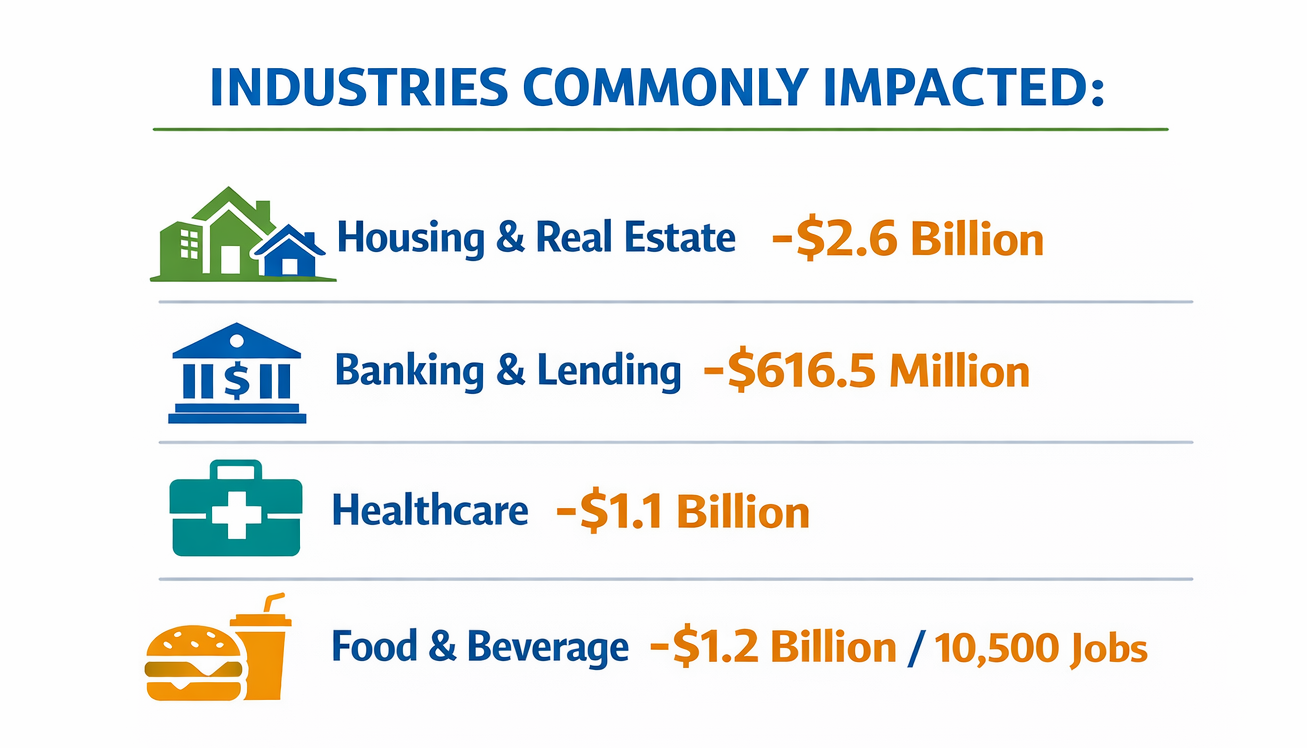
The analysis estimates that the housing sector, including owner-occupied housing, tenant-occupied housing, and other real estate services, could experience a $2.6 billion decline in economic activity.
Banking, Credit, and Lending
Migration also affects the financial system. Residents who relocate abroad frequently transfer savings from U.S. financial institutions and decrease their participation in domestic credit markets.
As a result, banking, credit, and lending offices could experience a $616.5 million reduction in economic activity due to fewer deposits, loans, and financial transactions.
Healthcare Services
Healthcare demand is closely linked to population size. A reduced resident base results in fewer hospital visits, physician appointments, and healthcare-related services.
The analysis estimates that hospitals and physicians’ offices could see a combined $1.1 billion decline in economic activity due to reduced patient demand.
Food and Beverage Industries
Population declines also impact consumer-facing industries, including restaurants, bars, and entertainment venues. With fewer residents spending locally, businesses in these sectors experience reduced customer volume.
The food and beverage industry alone could lose approximately $1.2 billion in economic activity and roughly 10,500 jobs due to reduced household spending.
Fiscal Impacts: Declining Tax Revenues
Population loss affects not only private businesses but also has significant consequences for public finances.
When residents emigrate, governments lose tax revenue associated with their income, purchases, and property ownership. These reductions impact local, state, and federal budgets, which depend on tax collections to fund public services.
The analysis estimates that negative net migration could result in a $2.6 billion reduction in combined government tax revenues.
Lower revenues may constrain funding for essential services such as:
- Infrastructure and transportation systems
- Public education
- Emergency services and public safety
- Community development programs
For governments already operating under constrained budgets, demographic shifts can rapidly result in increased fiscal pressure.
Why Migration Matters to the Economy
Migration plays a fundamental role in sustaining economic demand. Each resident contributes to the economy through both labor and daily expenditures on housing, food, healthcare, transportation, and services.
Permanent departures result in the loss of both workers and consumers. The reduction in spending propagates through businesses and supply chains, decreasing output, wages, and employment across multiple sectors.
The modeled results underscore that even a relatively modest population shift, such as 150,000 people in a nation of over 330 million, can generate multi-billion-dollar economic consequences.
What Happens If the Trend Continues?
If negative net migration persists into 2026 and subsequent years, the economic effects are likely to compound over time.
Continued population losses would mean:
- Ongoing reductions in household spending
- Lower demand for housing and services
- Slower labor-force growth
- Declining tax revenues for governments
Over time, these dynamics may contribute to broader economic slowdowns, particularly in industries highly dependent on population growth.
Turn Demographic Change Into Economic Insight
Population shifts, whether resulting from migration, birth rates, or demographic aging, have significant implications for economic growth. Understanding how these changes affect industries, employment, and public revenues is essential for policymakers, businesses, and economic developers.
IMPLAN enables analysts to model demographic scenarios and quantify the effects of population changes on household spending, labor markets, and industry demand. By tracing the impact of lost income and consumption throughout the economy, IMPLAN assists organizations in translating demographic trends into actionable economic insights.
Schedule a demo today to see how IMPLAN helps quantify population-driven economic shifts, evaluate industry exposure, and turn complex demographic trends into actionable economic analysis.


.png?width=80&name=IMPLAN_Logo_Print-Vector_NEW%20(2).png) Copyright 2025
Copyright 2025