
Each year, March Madness transforms host cities into short-term economic hubs, drawing hundreds of thousands of visitors and generating concentrated spending across local economies. While national attention focuses on the Final Four, the early rounds of the tournament generate substantial, measurable economic impacts.
This analysis employs IMPLAN modeling and an average visitor spending estimate of $361.75 per person to assess the economic contributions of early-round games in two major host regions: the men’s tournament in the Indianapolis metropolitan area and the women’s tournament in the Phoenix metropolitan area.
Even without accounting for team expenditures, athlete spending, or games hosted in other cities, the results indicate that early tournament play alone generates significant economic activity, employment, and tax revenue.
Early-Round Games Generate Nearly $400 Million in Economic Output
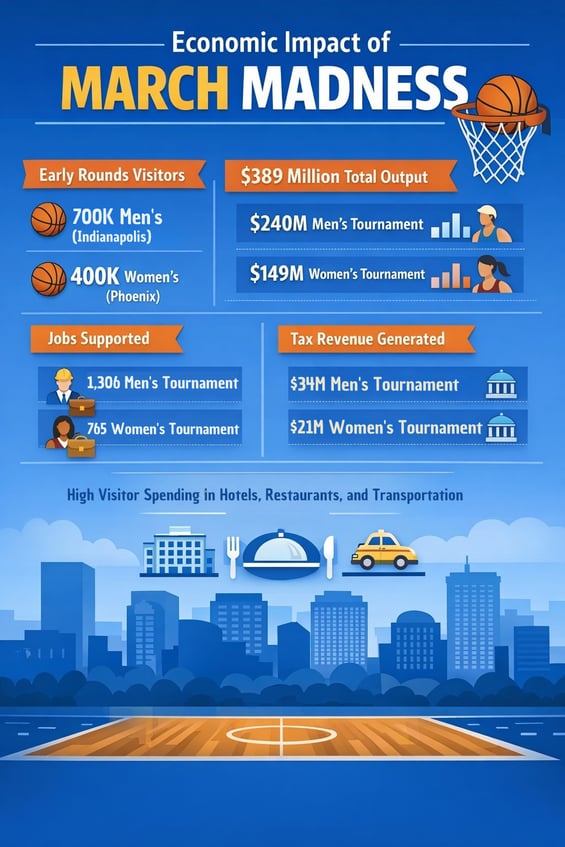
High visitor volumes result in direct local economic gains. The early rounds of March Madness attracted approximately 700,000 visitors to the Indianapolis metropolitan statistical area (MSA) for the men’s tournament and 400,000 visitors to the Phoenix MSA for the women’s tournament.
This influx of spending generated a combined total economic output of $389 million.
For the men’s tournament in the Indianapolis MSA, this includes $240 million in total output, $134 million in value added or GDP contribution, $80 million in labor income, and $34 million in tax revenue.
For the women’s tournament in the Phoenix MSA, this includes $149 million in total output, $85 million in value added, $48 million in labor income, and $21 million in tax revenue.
These impacts are concentrated in industries such as accommodations, food services, transportation, and entertainment, which are highly responsive to short-term tourism demand.
Visitor Spending Ripples Across Local Economies
Although direct visitor spending initiates economic activity, the full impact of March Madness extends beyond hotels and restaurants.
IMPLAN modeling captures three layers of economic effects: direct effects, which include visitor spending on lodging, dining, and transportation; indirect effects, which encompass supply chain activity supporting those industries; and induced effects, which reflect household spending by workers whose incomes are supported by tournament-related activity.
For example, in the men’s tournament, direct output accounted for approximately $135 million, while indirect and induced effects contributed an additional $105 million or more.
This illustrates how tourism expenditures circulate through the economy, supporting suppliers, service providers, and local businesses beyond the initial point of sale.
More Than 2,000 Jobs Supported Across Host Regions
The economic activity generated by March Madness translates directly into employment support.
Across both host regions, early-round games supported more than 2,000 jobs. This includes 1,306 jobs in the Indianapolis MSA and 765 jobs in the Phoenix MSA.
These jobs span a wide range of industries, including hospitality, transportation, wholesale trade, and business services, reflecting the broad reach of tourism-driven demand.
Strong Tax Revenue Generation for Local and State Governments
Large-scale sporting events also make significant contributions to public finances.
The men’s tournament generated approximately $34 million in tax revenue. The women’s tournament generated approximately $21 million in tax revenue.
These revenues support government expenditures on infrastructure, public services, and community investments, reinforcing the fiscal importance of event-driven tourism.
The Women’s Tournament Is Emerging as a Major Economic Driver
Although smaller in scale, the women’s tournament is rapidly increasing in economic significance.
With 400,000 visitors generating $149 million in output, the event supported 765 jobs and $48 million in labor income.
These results reflect rising attendance, visibility, and commercial impact, aligning with broader trends in the growth of women’s sports as a significant economic force.
Methodology
This analysis utilizes IMPLAN to model the economic impact of visitor spending associated with early-round March Madness games.
Average visitor spending of $361.75 per person was applied to estimated attendance figures in each host region. The model captures direct, indirect, and induced effects to quantify total economic output, employment, labor income, value added, and tax revenue.
The results represent a partial view of the tournament’s total economic footprint. This analysis does not include spending by teams, athletes, or event organizers. It also excludes economic activity from earlier or later rounds hosted in other regions.
Consequently, the full nationwide impact of March Madness is likely to be substantially larger.
A Short-Term Event With Lasting Economic Impact
Early rounds of March Madness generate significant economic benefits for host cities, producing nearly $400 million in output and supporting more than 2,000 jobs across two metropolitan areas.
These findings reinforce a broader pattern observed across tourism-driven events: concentrated visitor spending can serve as a powerful, short-term economic stimulus with ripple effects across industries and communities.
Turn Event-Driven Spending Into Economic Insight
Major events such as March Madness provide a clear example of how visitor spending translates into measurable economic outcomes.
IMPLAN enables analysts, economic developers, and policymakers to quantify these impacts with precision by capturing how tourism dollars flow through local economies, support jobs, and generate public revenue.
Schedule a demo today to see how IMPLAN helps you model event-driven economic activity, evaluate regional impacts, and turn complex data into clear, decision-ready insights.

.png?width=80&name=IMPLAN_Logo_Print-Vector_NEW%20(2).png) Copyright 2025
Copyright 2025