
The U.S. housing market is exhibiting signs of cooling, with the resulting slowdown extending well beyond real estate listings.
Recent data from Redfin shows that U.S. pending home sales fell 5.8% year over year during the four weeks ending February 15, 2026, marking the largest decline in a year. At the same time, homes are taking longer to sell. The typical home now takes 67 days to go under contract, a full week longer than in 2025 and the slowest pace since early 2019.
These shifts are significant because housing transactions serve as major catalysts for economic spending. Each home sale initiates a cascade of economic activity, including mortgage financing, renovation work, furniture purchases, and retail spending.
IMPLAN was used to model how the recent slowdown in home sales translates into broader economic impacts across industries and communities.
Modeling the Economic Impact of Slower Home Sales
The decline in pending home sales constitutes a substantial reduction in overall economic activity.
A 5.8% decline in housing transactions equates to approximately 56,000 fewer home sales annually. The absence of these transactions eliminates the associated spending. According to the analysis, this reduction in housing activity corresponds to an estimated $22.4 billion loss in U.S. GDP (value added).
This lost activity would otherwise have supported approximately 27,700 jobs across the U.S. economy and generated about $2 billion in labor income for American workers. Government revenues are similarly affected, with the slowdown eliminating an estimated $4 billion in combined local, state, and federal tax revenue associated with housing-related spending.
The slowdown does not remain confined to the real estate sector but instead spreads rapidly throughout the broader economy.
Why the Housing Market Is Stalling
Several factors are contributing to the slowdown in home sales.
First, affordability remains a major constraint. Many potential buyers are stepping back from the market because purchasing a home remains expensive relative to incomes and borrowing costs.
Additionally, sellers are reluctant to list properties in a market where demand appears diminished. Many homeowners prefer to wait rather than accept lower offers, especially if they believe their property should command a higher price.
Finally, seasonal and weather-related factors have played a role. Winter weather in many regions reduced in-person showings and slowed housing activity during the early part of the year.
Collectively, these dynamics have resulted in a temporary freeze in housing transitions, which carries significant economic consequences.
Where the Demand Loss Shows Up
A slowdown in housing activity affects a wide range of industries.
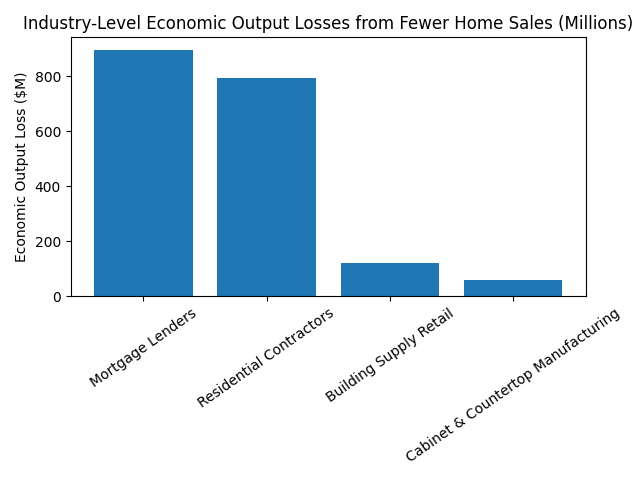
Mortgage lenders and financial institutions are among the most directly impacted. The sector classified as nondepository credit intermediation, which includes mortgage brokers and lenders, is missing out on nearly $897 million in economic output due to the slowdown in transactions.
Residential contractors and skilled trades also face significant losses. The industry category maintenance and repair construction of residential structures, which includes plumbers, roofers, and general contractors, loses approximately $794 million in potential activity as fewer homeowners invest in repairs and upgrades associated with listing or moving.
Retail and manufacturing sectors connected to home improvement are also affected. Building material and garden supply stores experience an estimated $122 million decline in activity, while manufacturers of goods such as wood kitchen cabinets and countertops see roughly $60 million in reduced demand.
In total, these secondary industries are experiencing losses exceeding $2.5 billion in economic activity as a result of the housing slowdown.
Why Housing Matters to the Broader Economy
Housing occupies a unique position in the economy because each home sale initiates a predictable sequence of spending.
When ownership of a home transfers, buyers frequently hire movers, pay for inspections, engage painters or plumbers, and purchase furniture, appliances, and landscaping supplies. Each of these activities generates additional economic activity that supports businesses and workers across multiple industries.
When 56,000 expected home sales do not occur, the entire associated spending chain slows or disappears. This outcome results not only in fewer real estate transactions but also in a measurable decline in overall economic momentum.
This slowdown also impacts public finances. Real estate transfer taxes, recording fees, and sales taxes associated with home-related purchases all decline when housing activity slows. The current slump represents approximately $4.1 billion in lost tax revenue, which many communities depend on to support public services such as schools, infrastructure, and emergency response.
What This Means for the Spring Housing Market
If the current trend continues for an entire year, the economic implications will become more pronounced.
The slowdown would translate to about 56,000 fewer homes sold annually, resulting in approximately $22 billion in lost economic output, 27,000 jobs affected across the economy, and $2.3 billion less in worker paychecks. Government revenues would decline by roughly $4.1 billion across local, state, and federal levels.
However, market dynamics may shift in the coming months. A slower market could develop into a stronger buyer’s market, providing buyers with greater leverage to negotiate prices or concessions. Housing activity may also improve as weather conditions become more favorable and if mortgage rates continue to decline from their current average of approximately 6.09%.
Nevertheless, a prolonged slowdown would result in the loss of one of the economy’s most reliable drivers of secondary spending. In the absence of consistent home transitions, industries related to renovations, moving services, and home goods may continue to experience economic contraction and job losses
Turn Housing Market Signals Into Economic Insight
Shifts in the housing market are often among the earliest indicators of broader economic change. Understanding how a reduction in home sales affects industries, employment, and public revenues is essential for businesses, policymakers, and economic developers.
IMPLAN helps organizations measure how changes in housing demand ripple through supply chains, local businesses, and regional economies. With IMPLAN, analysts can model housing-market scenarios, evaluate economic exposure, and communicate defensible results through a transparent methodology and trusted data.
Schedule a demo today to see how IMPLAN helps quantify housing market impacts, model industry ripple effects, and turn complex economic dynamics into clear, decision-ready insights.


.png?width=80&name=IMPLAN_Logo_Print-Vector_NEW%20(2).png) Copyright 2025
Copyright 2025